Agentic Stride.

Private AI / Built around your firm

Your firm’s knowledge
is its moat.
Keep it that way.

Decades of judgment. Thousands of matters.
An advantage that belongs to you.

Put modern AI to work on that knowledge, inside an environment your firm controls. From a dedicated cloud tenant to a completely air-gapped deployment.

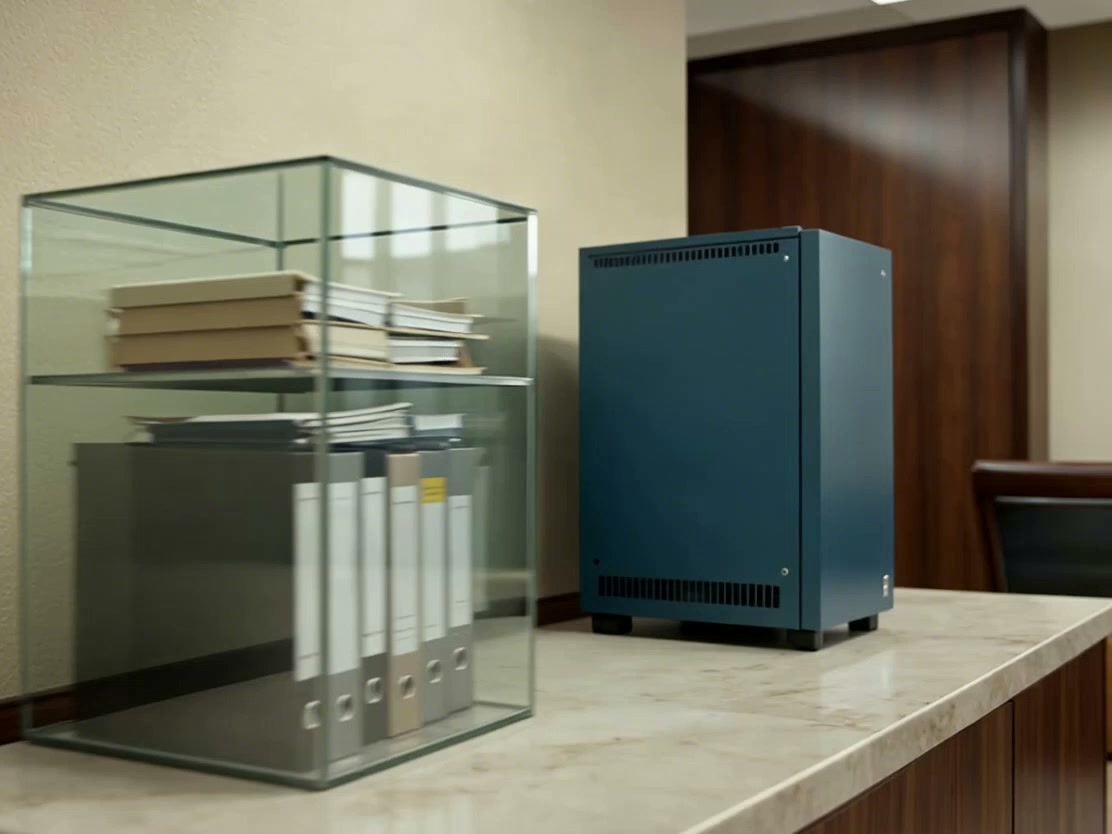
Conceptual illustration of a firm’s archive beside a private inference serverYour archive. Your environment.

Firm knowledge
Kept within your boundary.

Illustrative architecture · Original Seedance film

The value is already inside your firm

Your best work should
inform your next matter.

The opinion that resolved a difficult point. The clause refined over years. The pleading that captured a complex record. Your archive holds the experience a public model cannot know.

We help turn physical files, scattered folders and document repositories into a governed knowledge system—so that experience becomes easier to find, inspect and use, without giving up control of the underlying work.

OpinionsPrecedentsPleadingsDeal documentsMatter history
Why now≈4months

The estimated open-weight capability lag in Epoch AI’s May 2026 study.

Read the analysis ↗

The capability gap has narrowed.
The choice has changed.

Private deployment no longer automatically means choosing a model far behind the frontier. Epoch AI’s analysis found an average lag of about four months on its aggregate capability index from January 2026 through its study window.

That is a reason to evaluate, not a promise of equivalent legal reasoning. We test candidate models against your documents, languages, workloads and hardware before recommending a stack.

Published 29 May 2026. A stricter comparison in the same study gives six months. Benchmark results do not establish legal accuracy, response speed or performance on your infrastructure. Open-weight licences also vary.

From accumulated work to usable intelligence

One connected system.
Inside your boundary.

We curate the models, processing, retrieval and workflows around your practice. Each layer has a clear job—and a way to check its work.

Your firm’s private environment
01Your source recordArchives · DMS · File shares
02Private preparationOCR · Translation · Provenance
03Permission-aware indexExact terms + semantic retrieval
04Local models & agentsRetrieve · Reason · Cite
05Reviewed work productSources remain attached
SourcePageVersionAccess

No client document needs to leave this environment in a fully private deployment.

01 / Bring the record together

Start with what you have.

Bulk ingest years of work from your DMS, file shares and archives. Physical records begin with a controlled scanning process; digital files retain their matter, owner, version and source location.

We reconcile what was received, flag duplicates and unreadable pages, and build an exception queue. A large archive is useful only when you know what made it into the system.

02 / Make every page usable

Read it. Translate it. Keep the original.

Run OCR and translation inside your infrastructure, including for scanned records and mixed-language files. Keep original pages alongside extracted text and clearly labelled translations.

Review low-confidence extraction and material passages. Preserve page references so a lawyer can always return to the document—not just a summary of it.

03 / Find the knowledge that matters

Search by wording. Search by meaning.

Combine full-text and semantic search across the archive. Exact language helps find a clause or citation; semantic retrieval helps surface a relevant precedent expressed differently.

Matter permissions and ethical walls apply before retrieval. Changes to access, retention and document versions must flow through to the index and cached results.

04 / Put private inference to work

Your models. Your working context.

Ground assistants in the passages a user is allowed to see, then run inference on locally hosted, appropriately licensed models. This is retrieval-augmented generation: relevant source material accompanies the question, without needing to retrain a model on the whole archive.

Configure research, drafting and review agents around approved workflows. Answers link back to your precedents; uncertainty and missing evidence stay visible. Citations support scrutiny, rather than guarantee correctness.

05 / Make it dependable in practice

Keep lawyers in control.

Take a draft back to its sources, compare versions and record the reviewer’s decision. Access logs, evaluation sets and approval steps make the system accountable as models and documents change.

We pilot with a practice group, train the people doing the work and define who owns updates, incidents and ongoing support. The measure is useful, reliable work—not a convincing demonstration.
Choose where your AI runs

The boundary is yours to draw.

Data location is one decision. Who administers the system, holds the keys and controls its connections matters just as much.

A dedicated environment

Control, without your own server room.

A tenant dedicated to your firm, in an agreed jurisdiction, with private networking, defined administrator access and encryption-key arrangements.

  • Private OCR, retrieval and inference in the tenant.
  • Hosting, backups and support access agreed together.
  • Capacity sized for your workload and growth.

A region selection alone does not establish sovereignty. We assess provider access, key custody, contracts and operational dependencies.

An offline operating environment

All the way inside your walls.

Run ingestion, OCR, translation, search and inference on your servers, on an isolated network. A fully air-gapped design requires no live internet connection for these workflows.

  • Local model weights, embeddings and dependencies.
  • No runtime calls to external AI services or telemetry endpoints.
  • Controlled, reviewed imports for model and knowledge updates.

Air-gapped means no live research connectors. Updates and public-law material enter through a separately approved offline transfer process.

A deliberate division of work

Private knowledge. Connected research.

Keep client documents and confidential inference private. Where your policy permits, bring public-law research in through approved specialist services such as Veritect.

  • An explicit boundary between private matters and external research.
  • Reviewed queries that exclude client identifiers and confidential facts.
  • Approved destinations, audit trails and a clear stop when sharing is unsafe.

A research question can itself reveal client information. Connectors require a disclosure policy; they are optional and unavailable in fully air-gapped mode.

Your dedicated cloud tenant
DocumentsOCR + translationKnowledge indexPrivate inference
Your permissions.
Your operating policy.
External connections governed by your policy

Client work is processed within the tenant. Connections are configured explicitly.

Illustrative patterns. Final boundaries, controls and performance are agreed during architecture design and acceptance testing.

A straight answer on trade-offs

Private should be
a considered choice.

The newest commercial models can still lead on the hardest reasoning tasks. A private model also needs the right hardware, disciplined evaluation and people to operate it.

We help you draw that line matter by matter: private models for work touching client data; approved specialist or commercial tools for suitable public material. A hybrid approach is a choice, not a prerequisite.

Control you can exercise

Your data, access policy and configuration stay under agreed firm control. We document administrative access, retention, backups and an exit path. Model rights remain subject to their licences; we review those before deployment.

Economics you can plan

Move from dependence on external per-query pricing to capacity planning. Budget for compute, storage, power, support and refresh cycles. Cost still grows with concurrency, document volume and model size; private AI is not cost-free or automatically cheaper.

Security you can demonstrate

Verify network egress, access isolation, logging and recovery. Treat document content as untrusted input to agents, restrict tools and test prompt-injection scenarios. An air gap reduces external exposure; it does not replace internal security or legal review.

A platform your team can sustain

Agree the runbooks, training and support model. Set quality and latency thresholds with real work samples, then re-evaluate after model, prompt or retrieval changes. Keep your source corpus portable so the firm's knowledge outlasts any one model.

Bespoke, from the first decision

A plan your partners can trust.
A system your team can run.

01 / Discover

Map the work and the risk.

Prioritise practice needs, audit the archive, establish permissions and identify the material that must never leave your environment.

02 / Prove

Test before you commit.

Compare models and retrieval on an agreed sample. Measure citation fidelity, extraction quality, response time, hardware requirements and lawyer effort.

03 / Put into practice

Deploy. Train. Maintain.

Roll out in stages, reconcile the archive, train each role and establish ownership for security, model updates and day-to-day support.

Your next stride

Start with your knowledge.
Design the right home for it.

Bring your priorities, current systems and data constraints. We’ll discuss a suitable deployment pattern, a pilot scope and what needs to be proven before you invest.

No client files needed for the first conversation.
On the agenda

Practice priorities

Data & access boundaries

Deployment options

A focused pilot

Evidence & context

Research that informs the approach. Deployment decisions are tested against your own requirements.

  1. Epoch AI · Open and closed model capability gap ↗29 May 2026 · The benchmark comparison and its methodological limits.
  2. McKinsey · What is sovereign AI? ↗6 March 2026 · Control of data, technology and operations extends beyond storage location.
  3. McKinsey · The symbiotic enterprise ↗18 June 2026 · Proprietary knowledge and operating capability as sources of differentiation.

AgenticStride’s service design and recommendations are our own. These sources do not imply endorsement.

Your next stride

Plan your private
AI environment.

Leave a few details. Our team will get in touch to arrange your private AI architecture session.

What would you like to explore? (optional)
Areas of interest

We’ll use your details to respond to this enquiry. AgenticStride and Veritect share a lead management system. No marketing subscription is added.